Fun Ways to Practice Spelling Words: 8 Methods Ranked by Prep Time (With Printable Sheets)
The quickest spelling practice needs no preparation at all: look, say, cover, write, check. For variety across the week, here are eight methods ranked by how long they take you to prepare, with whether a student can do them alone. For the ones that need a printed sheet, one pasted list makes three spelling practice worksheets: a word scramble, a crossword and a sentence scramble.
The eight methods
Prep time is your time, per week, once the list exists. "Alone" means a student can do it without a partner or an adult checking each word. These are our ratings, not research findings.
| # | Method | Prep | Alone? | What the student does |
|---|---|---|---|---|
| 1 | Look, say, cover, write, check | None | Yes | Reads the word, covers it, writes it from memory, checks |
| 2 | Rainbow writing | None | Yes | Traces each word several times in different colors |
| 3 | ABC order | None | Yes | Rewrites the list in alphabetical order |
| 4 | Partner quiz | None | No, needs a partner | One reads the word aloud, the other writes it |
| 5 | Dictionary check | None, if dictionaries are in the room | Yes | Looks up each word and corrects their own spelling |
| 6 | Word scramble | A few minutes with the maker | Yes, with the key | Unscrambles each word and writes it correctly |
| 7 | Crossword with clues | A few minutes, plus writing clues | Yes, with the key | Reads a meaning clue and spells the word into the grid |
| 8 | Word sort by spelling pattern | About 10 minutes to make cards | Yes | Sorts word cards into pattern groups, then writes new words that follow each pattern |
How the methods fit the Grade 2 spelling standard
Common Core's Grade 2 language standard L.2.2 includes two spelling expectations. L.2.2.D asks students to "generalize learned spelling patterns when writing words", with the examples cage → badge and boy → boil. L.2.2.E asks them to "consult reference materials, including beginning dictionaries, as needed to check and correct spellings" (Common Core, Language, Grade 2).
- Word sorts (method 8) lead up to L.2.2.D. Sorting cards by pattern finds the pattern; the standard is about using it "when writing words", so finish the sort by having students write two or three new words that follow each pattern.
- The dictionary check (method 5) is L.2.2.E as written.
- Scrambles and crosswords (methods 6 and 7) make students produce the correct spelling from mixed-up letters or from a meaning. They are recall practice for the list, not pattern teaching. Pair them with a sort that week.
Three spelling practice worksheets from one weekly list
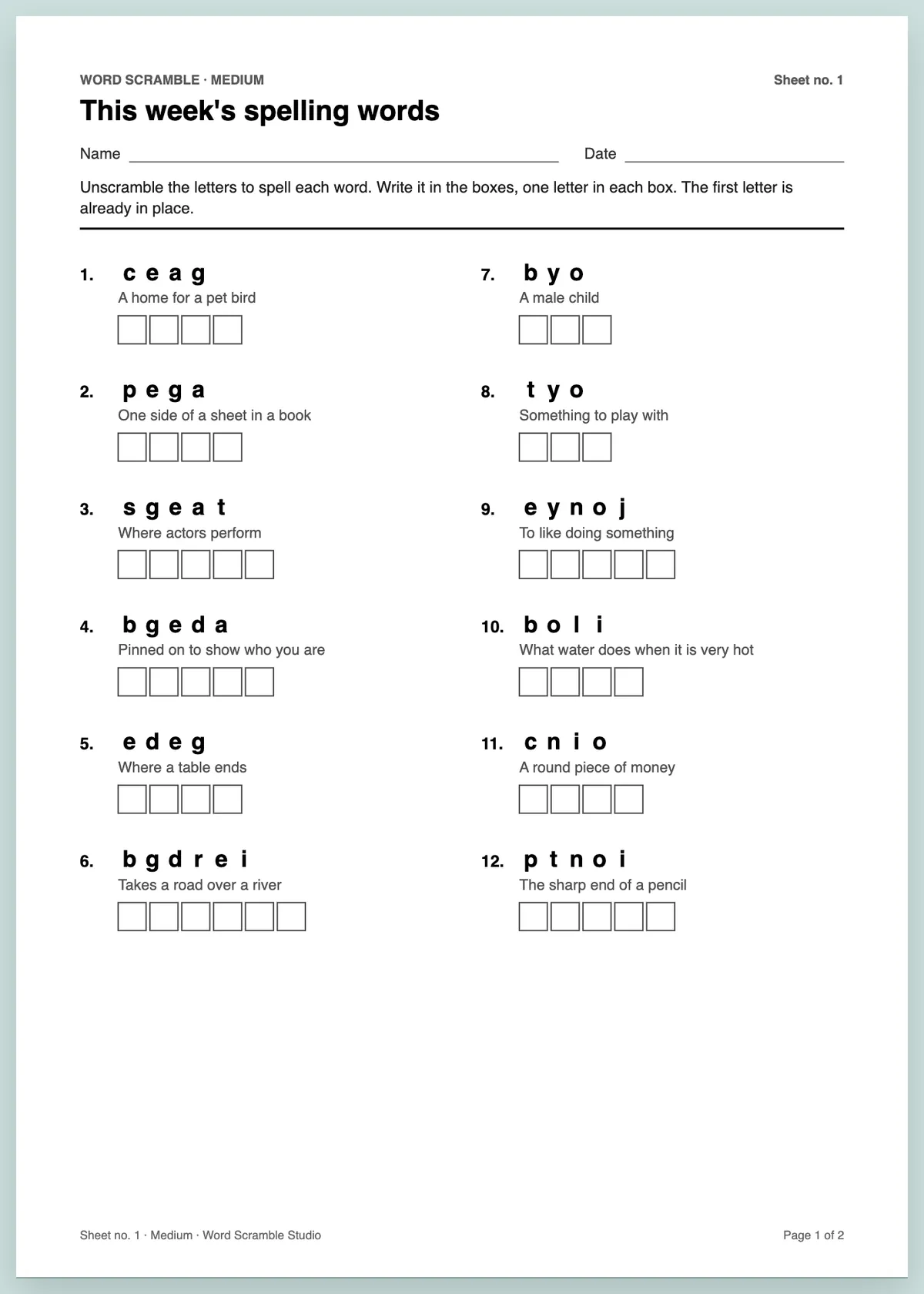
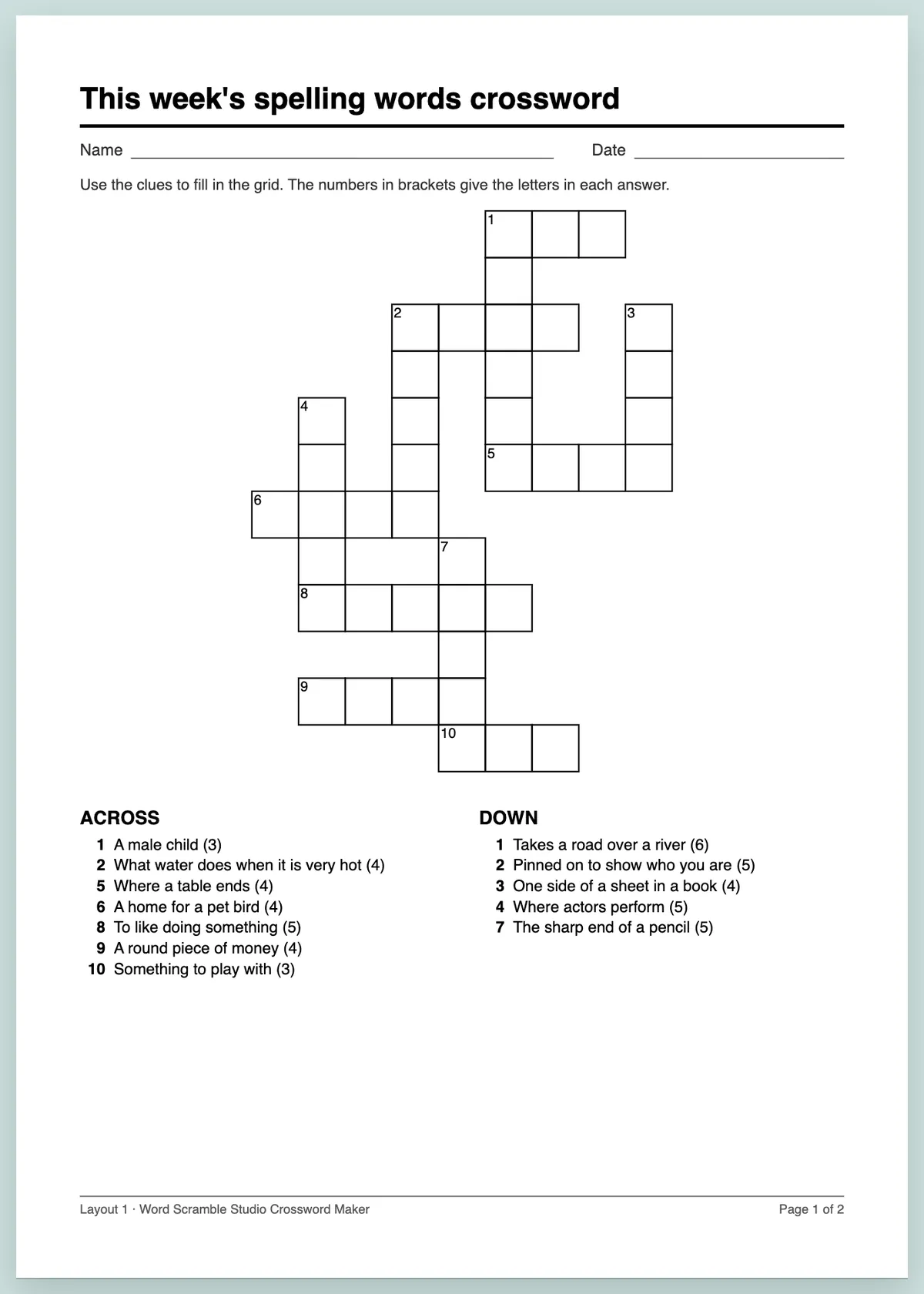
This example list is built on the standard's own examples (cage → badge, boy → boil): six words ending in the same /j/ sound and six with the same vowel sound spelled oy or oi. Look at the first six as a sort: the three spelled -ge have a long vowel (cage, page, stage) and the three spelled -dge a short one (badge, edge, bridge). That is the pattern the sort is for.
| # | Word | Clue (used by the crossword) |
|---|---|---|
| 1 | cage | A home for a pet bird |
| 2 | page | One side of a sheet in a book |
| 3 | stage | Where actors perform |
| 4 | badge | Pinned on to show who you are |
| 5 | edge | Where a table ends |
| 6 | bridge | Takes a road over a river |
| 7 | boy | A male child |
| 8 | toy | Something to play with |
| 9 | enjoy | To like doing something |
| 10 | boil | What water does when it is very hot |
| 11 | coin | A round piece of money |
| 12 | point | The sharp end of a pencil |
- Word scramble. Paste the list (or open this one), choose Medium, and pick Letter boxes under Puzzle so each answer shows its length.
- Crossword. Paste the same lines with a clue after a bar into the crossword maker. The clues test meaning as well as spelling.
- Sentence scramble. Write three or four sentences that use the words and paste them into the sentence scramble maker, for students who are ready to spell inside a sentence.
Choosing for your class
- No prep time this week: methods 1 to 4 need nothing but the list, and method 5 only needs dictionaries.
- Early finishers: a Hard scramble of the same words, printed as different sheets so neighbors have different scrambles.
- Testing the pattern, not the list: give a word sort with two or three new words that follow the same pattern (page → wage, coin → join).
Next steps
- Make the sheet: word scramble maker, crossword maker, sentence scramble maker.
- Seasonal practice in December: Christmas and winter word scrambles.
- More printables for the same age: printable mazes on Mazepad.
Sources
- Common Core State Standards: English Language Arts, Language, Grade 2 — https://www.thecorestandards.org/ELA-Literacy/L/2/, read November 10, 2026
More guides
- Christmas word scramble — 24 Christmas words and 24 winter words, three levels compared letter by letter, and 30 different sheets with one answer key.
- Baby shower word scramble — 40 baby words split into short and long lists, the arithmetic of why short words need a harder level, and numbered sheets against copying.
- Bridal shower word scramble — A 20-word bridal shower list and a 20-word wedding list, how phrases keep their word breaks, and adding the couple's own words.
- Valentine’s Day word scramble — A 20-word class-party list with no romance, a 20-word couples list, which level suits which age, and a different numbered sheet for every child.
- Printable word scrambles with answers — All 19 ready lists in one table, checked word by word against a 25,322-word list of common English: how many words have a second answer at each level, and three fixes.